
Worried About Radon? Get a Clear Answer — and a Mitigation System That Works.
Certified, Kentucky-licensed radon testing and mitigation across Kentucky. We measure your home's level, explain what it means, and install a system that brings it below the EPA's 4.0 pCi/L action level. Free quote in minutes.
- ✓ NRPP + KBRS Certified Partner Network
- ✓ Free Quotes · No Upfront Cost
- ✓ Kentucky Statewide Coverage
Who provides radon mitigation in Kentucky?
Kentucky Radon Experts connects Kentucky homeowners with NRPP-certified radon mitigation specialists. A typical sub-slab depressurization system runs $800–$2,500 with 50–99% radon reduction, and we route your request to a qualified local partner contractor. Free quote within 24 hours. Call (502) 453-5155.
A statewide lead-routing network for Kentucky homeowners.
Kentucky has roughly 97 NRPP-certified radon professionals — and as of July 1, 2024, every one of them must also register with the new Kentucky Board of Radon Safety (KBRS) under KRS §§ 309.430-309.454. Most don't advertise online. We screen homeowner requests against geology, foundation type, and timeline, then route your project to the right dual-credentialed Kentucky specialist within 24 hours.
Kentucky Radon Experts is a lead-routing service. All testing and mitigation work is performed by independent NRPP-certified and Kentucky Board of Radon Safety-registered partner contractors operating under their own licensing and insurance.
Check Your Radon Test Result Against the EPA Action Level
Enter your radon test result (in pCi/L) to see whether your Kentucky home meets the EPA action level — and exactly what to do next based on official EPA guidance.
Enter the picocuries-per-liter value from your charcoal canister or continuous radon monitor (CRM) report.
How the calculator maps test results to EPA guidance
| Radon level (pCi/L) | Risk tier | EPA-aligned recommendation |
|---|---|---|
| 0.0 – 1.9 | Below average — low | No action needed. Re-test every 2 years or after major renovation. |
| 2.0 – 3.9 | Elevated — EPA "consider mitigating" | Consider mitigation, especially with smokers, children, or lower-level bedrooms. Run a long-term (90+ day) test for confirmation. |
| 4.0 or higher | EPA Action Level — fix the home | Install an active radon mitigation system. EPA recommends fixing the home as soon as practical. |
How Much Does Radon Mitigation Cost in Kentucky in 2026?
The straight answer: a standard Louisville sub-slab depressurization install typically runs $1,000–$1,500, and most Kentucky residential mitigation falls inside an $800–$2,500 statewide band. That price is all-in — system design, materials, labor, and the post-mitigation verification test. Karst-foundation homes in the Bowling Green / Mammoth Cave region and split-foundation homes in Northern Kentucky tend to land on the higher end. Block-wall depressurization on older Inner Bluegrass farmhouses can run higher still.
| Project Type | Typical Home Size | Installed Cost | Lead Time |
|---|---|---|---|
| Active sub-slab depressurization (standard Louisville/Lexington) | Single-family, full basement | $1,000 – $1,800 | 1–3 weeks |
| Sub-membrane (crawl space — eastern KY coal-belt common) | Single-family, crawl | $1,500 – $3,500 | 1–3 weeks |
| Block-wall depressurization | Older Bluegrass home (pre-1980) | $2,000 – $4,000 | 2–4 weeks |
| Karst-foundation mitigation (Bowling Green / Hopkinsville) | Single-family on limestone karst | $1,400 – $2,800 | 1–3 weeks |
| Real estate closing mitigation (KRS § 324.360 disclosure) | Any single-family | $1,000 – $2,500 | 7–14 days (expedited) |
| Sump pump radon integration | Home with existing sump | $700 – $1,800 | 1–3 weeks |
| Multi-family / condo unit | Per unit | $1,200 – $3,500 | 3–6 weeks |
| Commercial building | Office / retail | $2,500 – $15,000+ | 4–8 weeks |
🆓 Haven't tested your Kentucky home yet? Get a free detector kit first.
Kentucky homeowners can check out a free radon detector kit from their county library through the University of Kentucky's "Radon on the RADAR" program (UK BREATHE, College of Nursing — funded by the National Institute of Environmental Health Sciences). If your test comes back at or above 4.0 pCi/L, that's when Kentucky Radon Experts steps in and connects you to an NRPP-certified, KBRS-registered mitigation specialist below.
How Does the Kentucky Radon Mitigation Process Work?
- Submit a free quote request — online form or phone call to (502) 453-5155. We capture your home details, county, foundation type, and timeline.
- Lead qualification — we verify Kentucky homeowner status, project scope, and any real estate closing window before routing to a partner.
- Partner routing — within 4 business hours, your project routes to the NRPP-certified, Kentucky Board of Radon Safety-registered contractor covering your service area.
- On-site assessment — the partner contractor visits within 2–7 days for a free site evaluation: foundation type (Inner Bluegrass basement, karst crawl, eastern KY coal-belt), radon entry pathways, and system design.
- Written quote — itemized estimate covering system design, materials, install, and post-mitigation verification testing. Most quotes arrive within 48 hours of the site visit.
- Schedule install — typical Kentucky lead time is 1–3 weeks from accepted quote. Real estate transactions referencing the KRS § 324.360 disclosure form can be expedited to 7–14 days.
- System installation — typical 4–8 hour install day for sub-slab depressurization in a poured-concrete basement. Karst crawl spaces and sub-membrane systems usually run 1–2 days.
- System activation + manometer mount — the radon fan is energized and a U-tube manometer is mounted in a visible spot so homeowners can confirm the system is running at a glance.
- Post-mitigation verification test — a 48–96 hour closed-house test starting at least 24 hours after activation. KBRS recommends verification within 30 days; EPA recommends confirmation that levels are below 4 pCi/L.
- Final report + warranty — the partner contractor delivers a written verification report (pre/post pCi/L documented) and warranty terms — typically a 5-year radon fan warranty and lifetime piping warranty.
Test First, Then Choose the Right Mitigation Method for Your Home
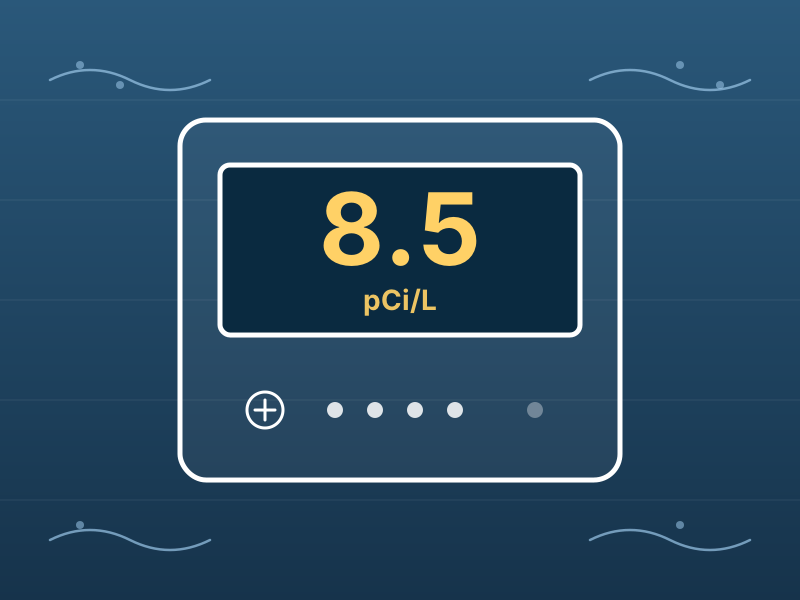
Radon Testing
Step 1 for every Kentucky homeowner. Professional testing, real estate transaction tests, and post-mitigation verification. If your reading is below 4.0 pCi/L, you may not need mitigation at all.
Learn more →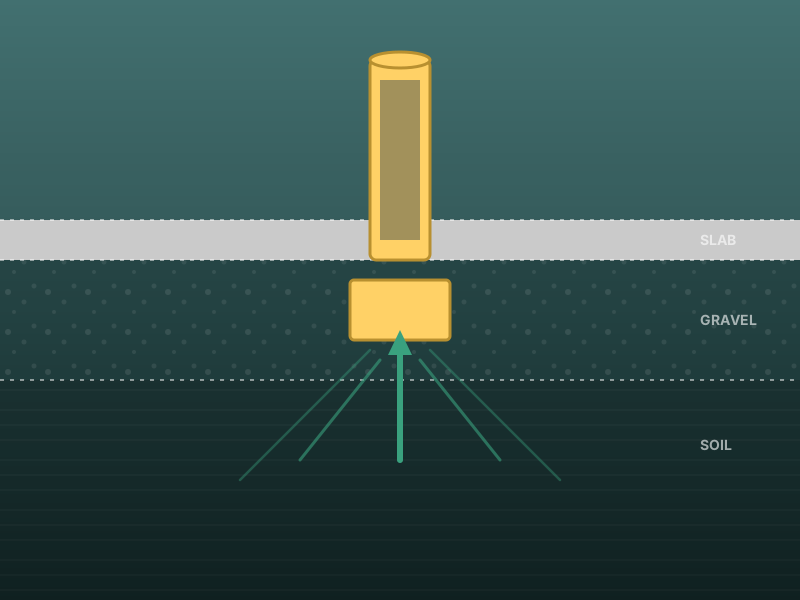
Sub-Slab Depressurization Installation
The standard method for homes with a basement — used in roughly 80% of Kentucky mitigation installs. A small pipe runs from beneath your basement slab, up through the home, and vents radon above the roofline.
Learn more →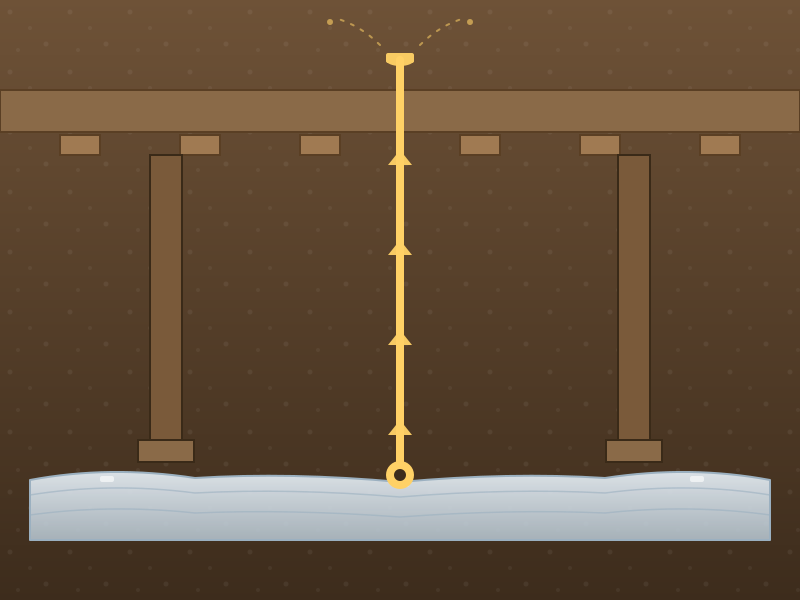
Crawl Space Radon Mitigation
For Kentucky homes with a crawl space instead of a full basement (common in older Eastern and Western Kentucky housing stock). A heavy-duty vapor barrier seals the floor, then an active fan vents radon above the roof.
Learn more →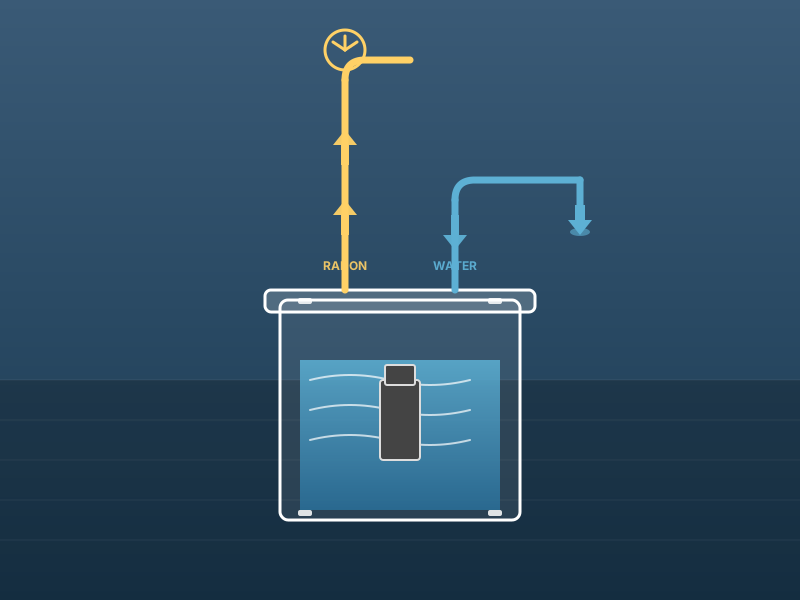
Sump Pump Radon Integration
Already have a sump pump? Often the most cost-effective mitigation — your existing sump basin doubles as the suction point, no need to drill a new hole in your slab. Common in Kentucky homes built after 1990.
Learn more →Not sure which mitigation method fits your home? In Kentucky, your foundation type answers most of it — basement homes use sub-slab depressurization, crawl-space homes use sub-membrane systems, and homes with an existing sump pump can often integrate the mitigation system into the sump for a lower install cost. Submit a free quote and a partner contractor will assess your home and recommend the right method.
Six Reasons Kentucky Homeowners Use Our Network
NRPP + KBRS Dual Credentials
Every partner contractor in our network holds active NRPP (or NRSB) certification and is registered with the Kentucky Board of Radon Safety per KRS §§ 309.430-309.454. Kentucky's 2024 transition from KDPH to KBRS tightened registration enforcement — we verify both credentials before routing any lead.
4-Hour Response Standard
Submit your request and a certified partner in your area replies within 4 business hours — no back-and-forth phone tag, no 3-day silence. Real-time SMS and email routing keeps the timeline tight, which matters most for Kentucky real estate transactions where the radon contingency clock is already ticking.
Full Lifecycle Service
From initial testing (charcoal canister, continuous radon monitor, or alpha-track) through system design, installation, and post-mitigation verification — our partner network owns every step. One contact, one written verification report, no fragmented handoffs between testing and mitigation companies.
KRS § 324.360 Disclosure Ready
Kentucky law requires sellers to disclose known radon test results and any installed mitigation system on the standard real estate disclosure form. Our partner network is fluent in the disclosure language, the warning statement, and the closing-timeline mitigations that keep deals on schedule.
Free, Transparent Quotes
On-site assessment is free. Quotes are itemized line by line. Standard Louisville sub-slab depressurization typically falls in the $1,000–$1,500 range; statewide most installs fit inside $800–$2,500. You pay the partner contractor only after the system is installed and verification confirms post-mitigation levels below 4 pCi/L.
Inner Bluegrass to Karst Belt Coverage
14 city service areas: Louisville, Lexington, Bowling Green, Owensboro, Covington, Hopkinsville, Florence, Richmond, Georgetown, Henderson, Elizabethtown, Frankfort, Nicholasville, and Independence. Statewide partner reach across all three Kentucky radon geologies — Inner Bluegrass limestone, south-central karst, and eastern escarpment.
Common Kentucky Radon Questions
Cost, how a system is installed, what it costs to run, radon levels, real estate, permits, and choosing a contractor — every question answered in one place.
Read the Full Radon FAQ →Kentucky Service Areas We Cover
Kentucky Radon Experts routes radon mitigation requests to NRPP-certified, KBRS-registered partner contractors across 14 Kentucky cities, with statewide partner coverage available. Click any city for location-specific radon data — county averages, EPA zone classification, and local geology.
Get a Free Kentucky Radon Quote in 24 Hours
Call (502) 453-5155 for same-day routing to an NRPP-certified, KBRS-registered Kentucky partner, or submit a quote request online. Quote response within 24 hours of submission. Free on-site assessment. No upfront cost.
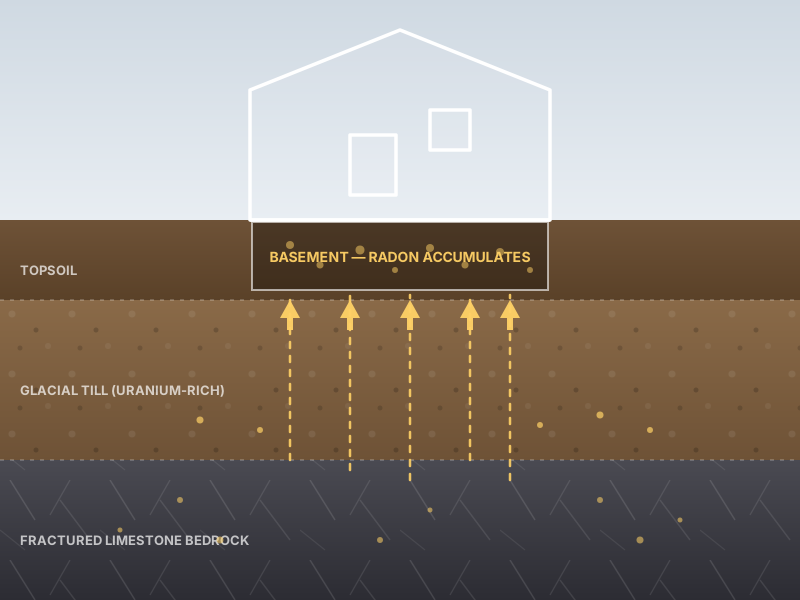
Why Does Kentucky Have America's Highest Radon Risk East of the Mississippi?
Kentucky's radon problem is fundamentally geological, not climatic. Three bedrock systems converge under the Commonwealth to produce more elevated indoor radon readings than any state east of the Mississippi River:
- Ordovician phosphatic limestone underlies the Inner Bluegrass — Fayette, Scott, Woodford, Bourbon, Clark, Jessamine, and Franklin counties. This uranium-bearing carbonate rock is the same formation Kentucky Geological Survey (KGS) identifies as the geological driver of the highest residential radon readings in the eastern United States. Scott County (Georgetown) tested homes average 15.0 pCi/L — the highest county average in Kentucky.
- Karst conduits in the Mammoth Cave region — Warren, Barren, Hart, and Edmonson counties — actively transport radon gas laterally through sinkholes and underground streams, concentrating it beneath homes regardless of season. Bowling Green sits squarely in this belt; Warren County tested homes average 14.0 pCi/L.
- The Eastern Bluegrass escarpment — Madison, Estill, Powell, and Rowan counties — marks the geological boundary where the Inner Bluegrass meets the Cumberland Plateau's coal-belt sedimentary rock. KGS mapping flags this transition zone as elevated despite EPA Zone 2 classifications.
Kentucky Geological Survey has aggregated more than 70,000 home radon tests and published the most detailed statewide indoor radon potential map in the country. The Haneberg 2020 GeoHealth study (UK Geological Survey) confirmed that bedrock lithology — not winter heating cycles — is the dominant predictor of indoor radon across the Commonwealth.
Kentucky's milder winters (Louisville's January overnight low averages 25.9°F, compared with roughly 10°F across the upper Midwest) mean stack effect plays a smaller role here than in colder states. Radon emanation from Inner Bluegrass limestone and karst gas transport continue year-round — which is why the Kentucky Board of Radon Safety recommends testing every Kentucky home regardless of zone classification.
The bottom line: Kentucky's statewide indoor radon average is 7.4 pCi/L — nearly twice the EPA action level of 4 pCi/L, roughly 5.7 times the national average of 1.3 pCi/L, and the sixth-highest in the United States.
📞 Get a Free Radon QuoteHow High Are Radon Levels in Your Kentucky County?
Kentucky's 120 counties split across all three EPA radon zones — 30 Zone 1, 67 Zone 2, and 23 Zone 3 — but the Zone 1 counties hold roughly 60% of the state's population, including Louisville/Jefferson, Lexington/Fayette, Bowling Green/Warren, and the Inner Bluegrass cluster around Scott, Jessamine, and Franklin. Below are tested-home averages and elevated-home percentages for the 14 cities we serve, sorted by severity. Scott County (Georgetown) leads with a 15.0 pCi/L average; Bowling Green's karst-belt geology pushes Warren County to 14.0 pCi/L.
| City | County | Average pCi/L | % Homes Elevated | EPA Zone |
|---|---|---|---|---|
| Bowling Green | Warren County | 14.3 | 70% | Zone 1 |
| Nicholasville | Jessamine County | 8.8 | 55% | Zone 1 |
| Lexington | Fayette County | 8.1 | 50% | Zone 1 |
| Georgetown | Scott County | 8.1 | 75% | Zone 1 |
| Elizabethtown | Hardin County | 6.8 | 73% | Zone 2 |
| Hopkinsville | Christian County | 5.7 | 38% | Zone 2 |
| Frankfort | Franklin County | 5.7 | 50% | Zone 1 |
| Louisville | Jefferson County | 5.3 | 62% | Zone 1 |
| Richmond | Madison County | 5.1 | 28% | Zone 2 |
| Florence | Boone County | 4.8 | 37% | Zone 2 |
| Henderson | Henderson County | 3.4 | 18% | Zone 2 |
| Covington | Kenton County | 3.2 | 37% | Zone 2 |
| Independence | Kenton County | 3.2 | 37% | Zone 2 |
| Owensboro | Daviess County | 2.8 | 55% | Zone 2 |
Which Radon Mitigation System Is Right for Your Kentucky Home?
Five mitigation methods cover the vast majority of Kentucky homes. Foundation type drives the choice, and Kentucky's foundation mix is more varied than most states — full basements dominate Northern Kentucky and the Inner Bluegrass cities, crawl spaces are common in the eastern coal-belt counties, and Bowling Green's karst plateau introduces split foundations and slab-on-grade builds that sit directly over limestone conduits. Your partner contractor confirms the right design during the on-site assessment.
| System Type | Foundation Match | Typical Cost | Effectiveness | Best For |
|---|---|---|---|---|
| Active Sub-Slab Depressurization (ASD) | Poured-concrete basement | $1,000 – $1,800 | 70–99% reduction | Most Louisville, Lexington, and Northern KY homes |
| Sub-Membrane Depressurization | Crawl space | $1,500 – $3,500 | 70–95% reduction | Eastern Kentucky coal-belt and rural homes |
| Block-Wall Depressurization | Hollow block-wall foundation | $2,000 – $4,000 | 60–90% reduction | Older Inner Bluegrass farmhouses (pre-1980) |
| Drain-Tile Depressurization | Perimeter drain tile present | $1,500 – $3,500 | 70–95% reduction | Newer Kentucky subdivisions with drain systems |
| Passive System Retrofit | New construction passive ready | $500 – $1,500 | 40–70% reduction | Activating builder-installed passive lines in Nicholasville / Northern KY new builds |
How Does a Radon Mitigation System Actually Work?
A radon mitigation system creates negative pressure beneath your home's foundation, intercepting radon gas as it rises from Kentucky's uranium-bearing Ordovician limestone and karst conduits before it can enter your living space. The 4-step infographic below shows exactly how the system protects your home 24/7 — year-round, regardless of season.
Commercial, Multi-Family, and Real Estate Radon Services
Our partner network includes specialists certified for higher-complexity radon scenarios beyond standard single-family mitigation — important in Kentucky because the state has no mandatory school radon testing law, no mandatory child-care testing law, and no statewide radon-resistant new construction code. Property owners, school districts, and HUD-funded developments often need a credentialed partner to design testing and mitigation from scratch.
Multi-Family Buildings
Apartment buildings, condos, and townhome developments require unit-by-unit measurement and building-scale mitigation design. Our partner contractors hold AARST-ANSI Multi-Family Measurement (MFM) and Multi-Family Mitigation (MFMT) certifications — increasingly important in Louisville and Lexington where multi-family stock has grown sharply since 2020.
HUD Compliance Projects
Federally-funded multi-family housing in Kentucky must meet HUD radon testing and mitigation standards. Our partner network handles compliance testing, mitigation design to HUD specifications, and the documentation HUD properties need to maintain continued federal funding.
Radon-Resistant New Construction
Kentucky has no statewide RRNC code, but the AARST-ANSI CCAH standard remains the industry reference. Builders working in Inner Bluegrass and karst counties benefit enormously from RRNC-spec foundations — a $400–$800 cost at construction beats a $1,500+ retrofit later. Partner specialists work directly with Kentucky builders on RRNC design.
Real Estate Transactions
Pre-purchase testing, KRS § 324.360 sell-side disclosure compliance, and closing-timeline mitigation — typical 7–14 day turnaround from test to verified install. Kentucky real estate radon contingencies handled across Louisville, Lexington, and Northern Kentucky's tri-county market.
School Districts & Childcare
Kentucky has no mandatory school or child-care radon testing law — though KARP (Kentucky Association of Radon Professionals) and ALA-Kentucky actively advocate for one. Districts that elect to test voluntarily can route through our partner network for AARST-ANSI-MA-MAH-compliant measurement and mitigation design.
Vapor Intrusion Remediation
Brownfield redevelopment sites and commercial buildings on contaminated land require sub-slab depressurization paired with VOC vapor intrusion controls — a growing concern across Louisville's riverfront and Northern Kentucky industrial corridors. Partner network includes specialists certified for combined radon + VOC mitigation.
Read Our Complete Kentucky Radon Guides
Deep-dive guides on every aspect of radon mitigation in Kentucky — from how systems work to choosing a KBRS-registered contractor.
Radon Mitigation System — Complete 2026 Kentucky Guide
How systems work, what equipment Kentucky uses, and what it costs.
Read the complete guide → 🎨 With Animated DiagramHow Does Radon Mitigation Work?
Cross-section diagram of soil gas flow, fan operation, and venting.
See the diagram → 💰 PricingKentucky Radon Mitigation Cost in 2026
Typical Kentucky cost: $800–$2,500. City-by-city pricing breakdown.
See Kentucky pricing → ⚠️ Health RiskIs Radon Dangerous? Kentucky Health Risks Explained
Why radon is the #2 cause of lung cancer — and why Inner Bluegrass counties lead the East.
Understand the risk → 🔧 Technical Deep-DiveSub-Slab Depressurization (ASD)
Kentucky's #1 mitigation method — used in ~80% of installs.
Technical guide → 📊 Decision GuideRadon Testing vs Radon Mitigation in Kentucky
When to test, when to mitigate, and what each costs.
Compare options → ⚖️ Kentucky LegalDIY vs Professional Radon Mitigation in Kentucky
Why DIY radon mitigation is illegal in Kentucky — and what to do instead.
Read the comparison → ✅ Buyer GuideHow to Choose a Kentucky Radon Contractor
Credentials to require, red flags to spot, questions to ask.
Vet contractors → 🏠 For RealtorsKentucky Realtor Resources
Kentucky disclosure law, closing-timeline mitigation, the real estate process.
Realtor resources →